
Haiti celebrates 222 years of Independence…and Jacmel celebrates Carnival
The parades are over, the Soupe Joumou is all gone. Haiti Independence Day, celebrated annually on January 1st, was a moment for Haitians worldwide to commemorate their unique and revolutionary past while reflecting on the ongoing struggles and future aspirations of the nation.
Southeast Haiti, like the rest of the nation, celebrated its Independence Day on January 1st, 2026, showcasing remarkable resilience by honouring their freedom and heritage, despite the devastating impacts of Hurricane Melissa in late 2025, which caused significant flooding, deaths, and homelessness, particularly around Petit-Goâve. The spirit of Haitian Independence — rooted in revolution and survival — fueled their determination to celebrate their freedom and rebuild their nation.
Haiti, the world’s first Black republic, was born out of extraordinary courage and sacrifice. That legacy of resilience, resistance and self-determination continues to define the nation and its people, even as they rebuild. In essence, while Hurricane Melissa left deep wounds, the spirit of Haitian independence — rooted in revolution and survival — fueled the determination to rebuild their nation.
Resilience…
In the months following the devastation caused by Hurricane Melissa, the people of southeastern Haiti have once again shown the world the true meaning of resilience. Homes were damaged, livelihoods disrupted, and entire communities forced to confront yet another difficult chapter in a long history of hardship. Yet, amid the rubble and the ongoing work of rebuilding, something remarkable has endured: the unbreakable spirit of the Haitian people.
Everywhere in the region, signs of recovery are visible. Neighbors help one another clear debris, repair roofs, and restore daily routines with whatever resources they can find. A major issue was the loss of the autumn food harvest and water contamination, which international humanitarian organisations such as Hanwash have been addressing. Progress is often slow and challenging, but it is driven by determination rather than despair. For many families, rebuilding is not just about reconstructing houses—it is about restoring dignity, hope, and a sense of normalcy.
Perhaps nothing symbolizes this strength more powerfully than the decision to still celebrate Carnival. In Jacmel, music, color, dance, and laughter returned to the streets, not as an act of denial, but as a declaration of survival. Carnival became a statement: despite loss and uncertainty, life goes on, culture endures, and joy remains an essential part of healing.
Known as Haiti’s cultural vanguard, Jacmel kicked off its celebrations on January 18 with street parades featuring dancers, masks, and traditional “rope throwers”, under the theme “Jacmel in Our Dreams.” (Jakmèl nan rèv nou!). According to Vilbrun Emerson, in a post shared on the City Hall’s social media, this theme is part of “a poetic, memorial, and forward-looking approach.” It draws inspiration from the work of writer and poet René Dépestre, a native of Jacmel, who is celebrating his centenary this year.
The launch drew thousands of residents and visitors into the streets for a day of music, dance, visual spectacle and a time to forget the challenges and build hope for the future.
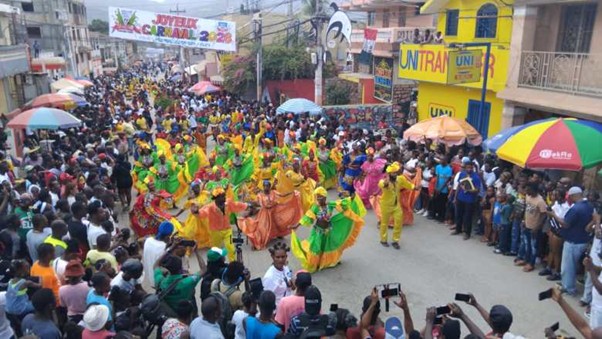
Jacmel Carnival Jan 18, 2026.
Credit: Photo by Fanise Davide Lejustal for The Haitian Times.